
Structural Strength of SIP Panels – More Than Just Insulation
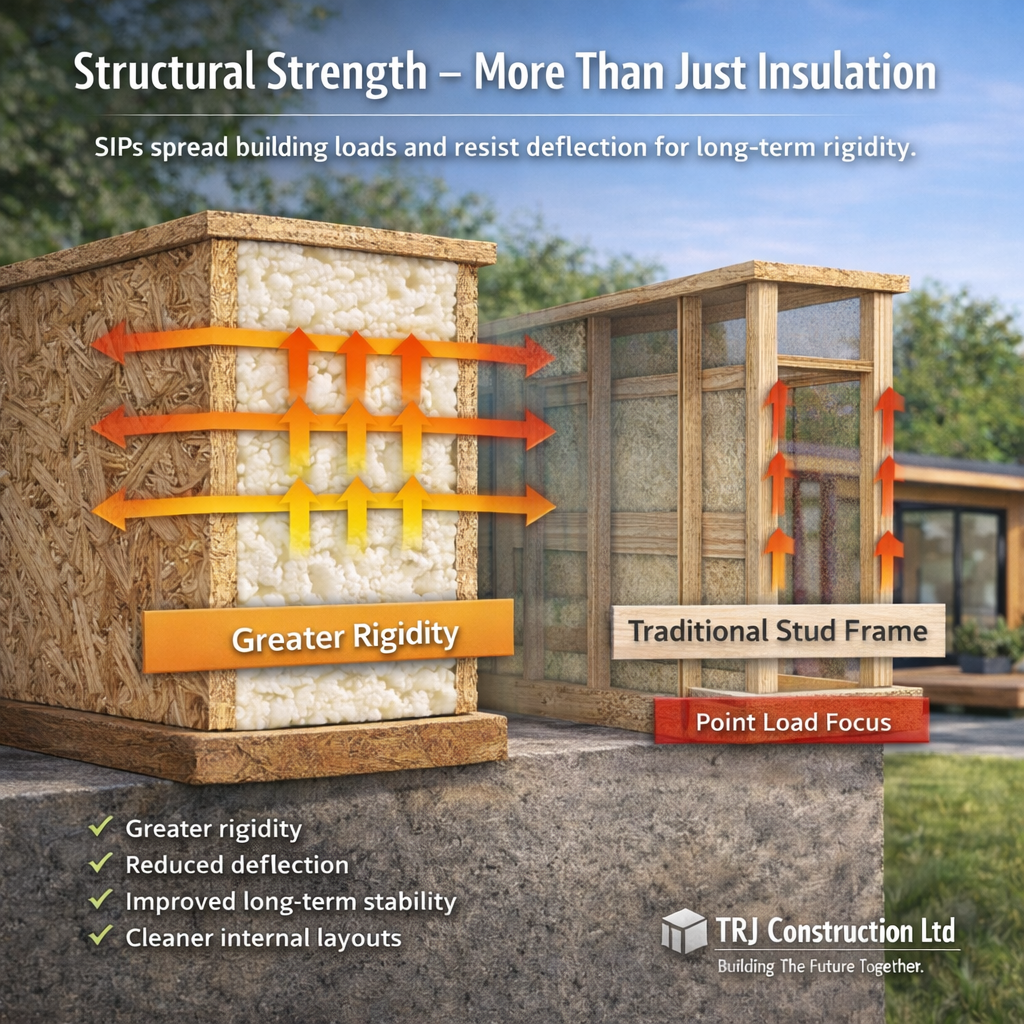
When people hear “Structural Insulated Panels,” they often focus on insulation.
But the word structural is there for a reason.
A properly engineered SIP panel is not just an insulated wall — it is a load-bearing composite structural element.
And that distinction matters.
How SIP Panels Distribute Load
A SIP panel distributes load across its entire surface.
Unlike traditional stud walls — which rely on repeated vertical timber members to carry structural loads — SIP construction works differently.
In a SIP wall:
- The OSB skins act as structural flanges
- The insulation core acts as a shear web
- The bonded panel functions as a single composite unit
Instead of load being concentrated at individual studs, it is spread continuously across the panel surface.
This produces a fundamentally different structural behaviour compared to traditional timber frame construction.
SIP vs Timber Frame – Structural Differences
In a typical stud wall:
- Vertical timber members carry most of the load
- Insulation sits between studs
- Structural rigidity depends on repetitive framing
In contrast, SIP panels:
- Reduce internal framing
- Minimise thermal bridging
- Provide large, uninterrupted structural spans
The result is a more uniform load path and improved overall rigidity.
For garden annexes and extensions, this structural consistency directly affects performance over time.
Key Structural Advantages of SIP Construction
Because SIP panels act as composite structural systems, they provide:
- Greater rigidity
- Reduced deflection
- Improved long-term dimensional stability
- Cleaner internal layouts with fewer structural interruptions
Reduced internal framing also allows for more efficient use of space — particularly important in granny annexes where layout efficiency matters.
Why Structural Rigidity Matters in Garden Annexes
For buildings in North London, Hertfordshire and surrounding counties, seasonal movement can affect lower-spec structures.
Temperature variation, moisture changes and structural loading all influence how a building behaves over time.
Structures that move more:
- Are more likely to develop hairline cracks
- Can experience finish stress
- May show long-term settlement issues
Structures that move less:
- Crack less
- Maintain alignment better
- Protect internal finishes longer
And buildings that crack less last longer.
This is not simply about strength.
It is about stability.
Structural Integrity and Long-Term Value
When designing a SIP granny annexe or garden extension intended for year-round use, structural performance should be considered alongside thermal performance.
A rigid structural envelope contributes to:
- Long-term durability
- Better performance of plasterboard and finishes
- Reduced maintenance requirements
- Improved perceived solidity
Clients often describe well-built SIP buildings as “solid” — and that perception is grounded in structural behaviour.
Our Structural Approach at TRJ Construction Ltd
At TRJ Construction Ltd, we approach SIP construction as an engineered structural system.
We consider:
- Load distribution
- Panel specification
- Roof span design
- Foundation interface
- Long-term movement control
Because insulation is only part of the story.
The structural envelope defines the building’s lifespan.
That is why we position ourselves as Structural Insulated Panel specialists serving North London and the Home Counties — not simply installers of garden rooms.
When structural integrity is correct, everything above it performs better.